
AI Copilots 2026: How They Are Helping Users
The integration of the IA 2026 copilots It has ceased to be a futuristic promise and has become the silent engine that drives everyday productivity.
Advertisements
These assistants, now embedded in the core of our operating systems, have evolved from simple text generators to autonomous agents capable of reasoning and executing workflows with an accuracy that is sometimes frightening.
In this analysis, we explore how these tools are redefining our interaction with the digital world.
We will analyze its impact on employment, the personalization of learning, and the dilemmas that arise when delegating critical decisions to algorithms that, although advanced, are still massive processing black boxes.
What are artificial intelligence copilots and how have they changed?
Unlike the rudimentary chatbots of a couple of years ago, today's copilots function as an additional layer of thought.
Advertisements
These systems don't just read words; they understand the historical context of your documents, emails, and preferences to offer suggestions that feel strangely personal.
In 2026, the fundamental difference is "agency." We no longer need to guide the machine by the hand.
Modern assistants can plan and execute complex tasks, such as organizing a business trip, by integrating cross-calendars and budgets without us having to intervene at every intermediate step.
There is something unsettling about the speed with which we have normalized this assistance.
This is often misinterpreted as intellectual laziness, but I see it more as a necessary liberation: we delegate the mechanical to try to rescue the creativity that the excess of digital bureaucracy had stolen from us.
How do IA 2026 copilots help in the daily professional environment?
The greatest progress is seen in the elimination of "management fatigue".
Today's professionals use these assistants to dissect lengthy meetings into clear action points or to draft legal documents based on case law that is updated in real time as they write.
In the world of programming, the act of writing code has been transformed into an architectural task.
The copilot suggests the backend structure, while the developer focuses on business logic and security, drastically reducing delivery times.
To understand the economic implications of this transformation in the workforce, institutions such as the World Economic Forum They offer detailed reports on the evolution of employment and the new skills demanded by this hybrid ecosystem.
AI Assistant Capabilities (2024 vs. 2026)
| Feature | Generative AI (2024) | IA 2026 Copilots | Real Benefit |
| Reasoning | Simple text patterns | Multithreaded logic and scheduling | Problem solving, not just text |
| Context | Limited to the session | Historical and local memory | Frictionless customization |
| Execution | It only suggests | Interact with apps and APIs | Real task automation |
| Multimodality | Basic text and image | Real-time video and voice | Fluid human interaction |
| Privacy | Cloud dependence | On-chip processing (Edge) | Security for sensitive data |
Why is local processing (Edge AI) the key this year?
Privacy was, for a long time, the elephant in the room.
In 2026, new processors with dedicated neural units will allow the IA 2026 copilots live and breathe within your device, without needing to send every thought to an external server.
Read more: Productivity with AI 2026: New ways of working
This architecture is what has finally convinced the most skeptical sectors.
By processing information locally, latency disappears and security increases; your financial or medical data doesn't travel over the network, it stays on the silicon you have on your desktop.
This data sovereignty has driven adoption in the legal and banking sectors, where trust is the main asset.
We no longer depend on blind faith in the terms of service, but on the physical infrastructure that we directly control.
Which sectors benefit the most from this technology?
Personalized medicine has taken a quantum leap.
The co-pilots help doctors cross-reference genetic data with medical records in seconds, enabling preventative diagnoses that previously required weeks of medical boards and manual analysis.
Read more: Digital tools that grew thanks to AI in 2026
In the educational field, we are seeing the end of the rigid curriculum.
Intelligent tutors adapt the pace of teaching to each student's profile, proactively detecting knowledge gaps and generating support material that fits each student's learning style.
Even in the arts, these tools act as a tireless technical collaborator.
The artist maintains the aesthetic helm, while AI takes care of the heavy tasks of rendering, supporting animation or audio cleaning, democratizing high-quality production.
How to choose the right assistant for your needs?
There is no one-size-fits-all tool, and trying to find one is a common mistake. Some users need deep integration with spreadsheets, while others are looking for specialized co-pilots for market analysis or managing digital communities.
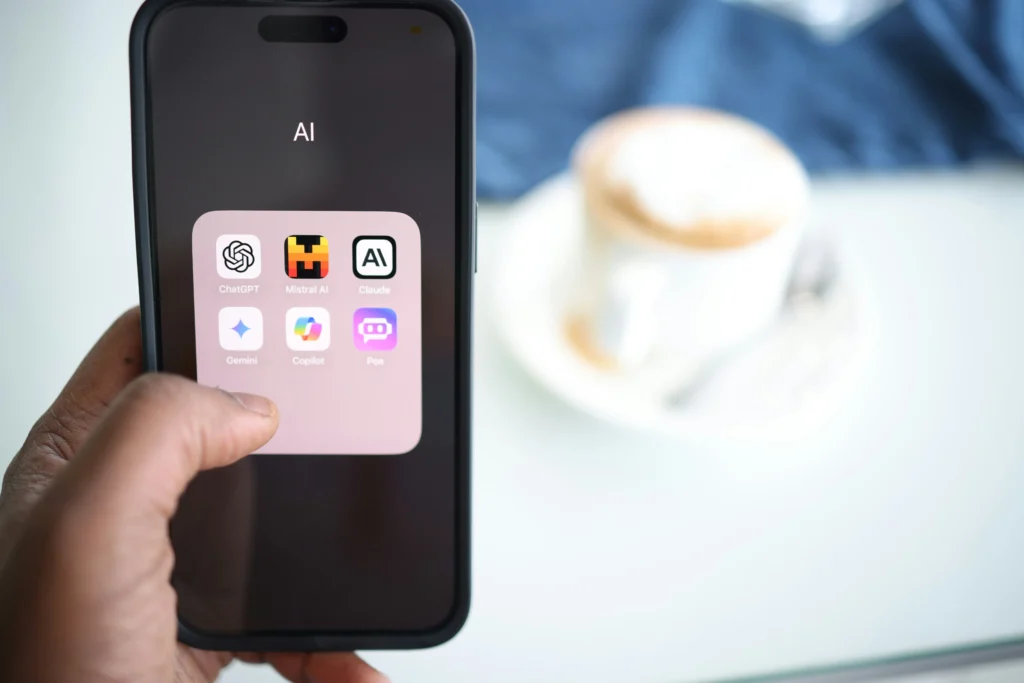
The key is interoperability. A copilot that feels like a sealed compartment ends up being a hindrance.
Read more: Tips for a healthier lifestyle using apps
Success lies in choosing one that "speaks" to your daily tools and is able to learn from your productive biases to anticipate your next move.
The versatility of the IA 2026 copilots Its strength lies in its ability to mimic you. Over time, the assistant begins to reflect your tone, your priorities, and your peak focus times, becoming a digital extension of your own work methodology.
What ethical challenges remain in the use of these assistants?
Despite the technological euphoria, absolute dependence raises legitimate doubts.
There is a real risk of atrophying critical skills; if AI writes and calculates for us, what will happen when the system fails or when we need to apply human judgment that the code does not possess?
We also face the problem of invisible biases.
If the co-pilot feeds on data with historical biases, its strategic recommendations could perpetuate inequalities without us realizing it, forcing us to maintain constant and active ethical vigilance.
To delve deeper into the regulatory frameworks and guidelines on autonomous software development, the portal of the European Union on AI It details the rules that attempt to bring order and protect citizens' rights in this virgin territory.
FAQ: Frequently Asked Questions about AI Copilots
Will these assistants replace my job?
It's unlikely that AI will replace you on its own, but a professional who masters co-pilots will almost certainly have an insurmountable competitive advantage over someone who chooses to ignore them. Efficiency is the new standard.
Is it safe to share confidential information with them?
Only if you ensure you're using versions with local processing or encrypted corporate clouds. Never assume that a free assistant protects your intellectual property in the same way as a professional tool designed for businesses.
What happens if the co-pilot makes a serious mistake?
Legal and professional responsibility remains human. Co-pilots are support tools, not legal entities. Therefore, monitoring the final outcome remains the user's most important task in 2026.
The consolidation of the IA 2026 copilots It marks the end of passive computing. We have stopped giving orders to machines and have begun to collaborate with entities that understand our purpose.
This evolution forces us to rethink what value we bring as humans when technical execution is no longer an obstacle.
Success in this new paradigm will depend on our ability to manage these systems with sound judgment and strategic vision.
In the end, the copilot handles the controls, but you remain the captain who decides the course of the journey. Technology has matured; now the limit is not the software, but the clarity of our own ideas.
\